Webhooks
Webhooks let Agenta notify another system when something changes. You can use them to update internal tools, sync deployed prompts into another service, or trigger downstream automation after a deployment.
When to use webhooks
Use a webhook when you want Agenta to push an event to your system.
Common use cases:
- update a service after a prompt deploy
- trigger a CI/CD job
- notify an internal platform tool
- sync prompt metadata into another store
If you want your application to fetch the latest prompt on demand, use Fetch Prompts via SDK/API.
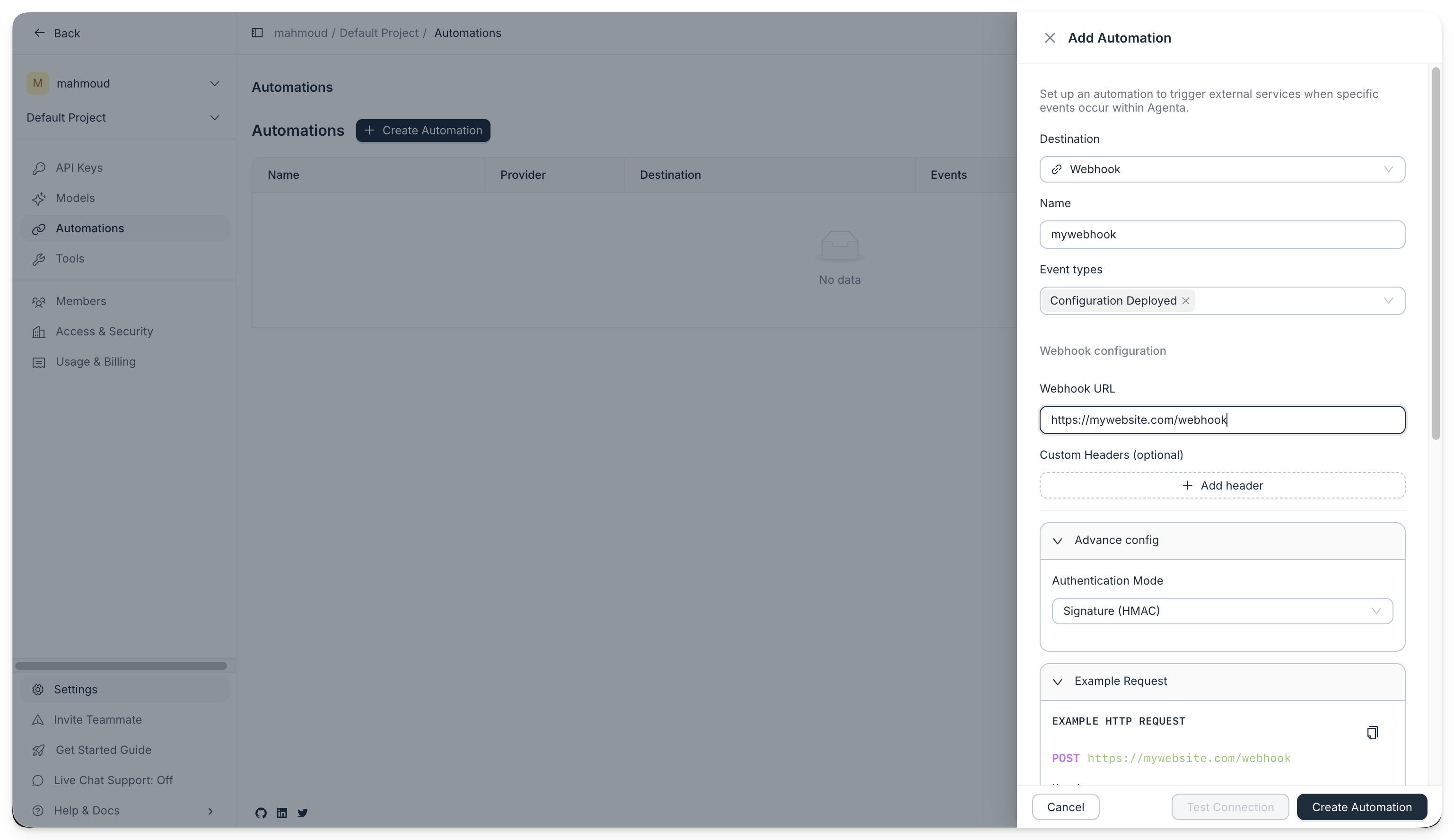
Set up a webhook in the UI
- Open your project in Agenta.
- Go to
Settings. - Open the
Automationssection.

- Click
Create automation. - Choose
Webhook. - Enter your HTTPS endpoint.
- Choose an authentication mode:
Signatureif your receiver should verify an HMAC signatureAuthorization headerif you want Agenta to send a bearer token
- Select the events you want to subscribe to.
- Save the automation.
- Copy the secret when Agenta shows it. You will need it to verify future deliveries.
After you create the automation, Agenta sends an HTTP POST to your endpoint every time the selected event happens. For example, if you subscribe to deployment events, Agenta sends a delivery each time you deploy a new prompt revision.
What Agenta sends
For environments.revisions.committed, the current webhook body is the event attributes object.
{
  "references": {
    "environment": {
      "id": "019c2b74-d84f-7cf2-aff0-e45e116e26cb"
    },
    "environment_revision": {
      "id": "019cd9b8-e21c-7c73-82a2-099cb1352f19",
      "slug": "5baf5e00de25",
      "version": "13"
    },
    "environment_variant": {
      "id": "019c2b74-d85c-7803-8a55-f12f2fc8f461"
    }
  },
  "user_id": "019315dc-a332-7ba5-a426-d079c43ab776"
}
Agenta also sends system headers like these:
Content-Type: application/json
User-Agent: Agenta-Webhook/1.0
X-Agenta-Event-Type: environments.revisions.committed
X-Agenta-Delivery-Id: <delivery_id>
X-Agenta-Event-Id: <event_id>
Idempotency-Key: <delivery_id>
Authentication modes
Using signature mode
Use signature mode when the receiver should verify that the request really came from Agenta and that the payload was not changed in transit.
Agenta signs each delivery and sends:
X-Agenta-Signature: t=<unix_ts>,v1=<hex_hmac>
Agenta computes the signature as:
HMAC_SHA256(secret, "{timestamp}.{raw_body}")
The important detail is raw_body. Agenta signs the exact JSON string it sends over HTTP.
To verify the signature:
- Read the raw request body before modifying it.
- Parse
t=andv1=fromX-Agenta-Signature. - Compute
HMAC_SHA256(secret, "{timestamp}.{raw_body}"). - Compare your result with
v1=using constant time comparison. - Reject old timestamps to reduce replay risk.
- Python
- TypeScript
import hashlib
import hmac
import os

from fastapi import FastAPI, HTTPException, Request

app = FastAPI()
WEBHOOK_SECRET = os.environ["AGENTA_WEBHOOK_SECRET"]


@app.post("/webhook")
async def webhook(request: Request):
    signature_header = request.headers.get("x-agenta-signature")
    if not signature_header:
        raise HTTPException(status_code=401, detail="Missing signature")

    parts = dict(piece.split("=", 1) for piece in signature_header.split(","))
    timestamp = parts.get("t")
    received = parts.get("v1")
    if not timestamp or not received:
        raise HTTPException(status_code=401, detail="Malformed signature")

    raw_body = (await request.body()).decode("utf-8")
    expected = hmac.new(
        WEBHOOK_SECRET.encode("utf-8"),
        f"{timestamp}.{raw_body}".encode("utf-8"),
        hashlib.sha256,
    ).hexdigest()

    if not hmac.compare_digest(received, expected):
        raise HTTPException(status_code=401, detail="Invalid signature")

    payload = await request.json()
    return {"received": True, "payload": payload}
export default async function handler(req: Request): Promise<Response> {
  const signatureHeader = req.headers.get("x-agenta-signature")
  if (!signatureHeader) {
    return new Response("Missing signature", {status: 401})
  }

  const parts = Object.fromEntries(
    signatureHeader.split(",").map((piece) => {
      const [key, ...rest] = piece.split("=")
      return [key, rest.join("=")]
    }),
  )

  const timestamp = parts.t
  const received = parts.v1
  if (!timestamp || !received) {
    return new Response("Malformed signature", {status: 401})
  }

  const rawBody = await req.text()
  const secret = process.env.AGENTA_WEBHOOK_SECRET
  if (!secret) {
    return new Response("Server misconfigured", {status: 500})
  }

  const key = await crypto.subtle.importKey(
    "raw",
    new TextEncoder().encode(secret),
    {name: "HMAC", hash: "SHA-256"},
    false,
    ["sign"],
  )

  const signatureBytes = new Uint8Array(
    await crypto.subtle.sign(
      "HMAC",
      key,
      new TextEncoder().encode(`${timestamp}.${rawBody}`),
    ),
  )

  const expected = Array.from(signatureBytes)
    .map((b) => b.toString(16).padStart(2, "0"))
    .join("")

  if (expected !== received) {
    return new Response("Invalid signature", {status: 401})
  }

  return new Response(JSON.stringify({received: true}), {
    status: 200,
    headers: {"Content-Type": "application/json"},
  })
}
Here is a working example hosted on Val Town.
Authorization header mode
In authorization mode, Agenta sends your stored secret as the Authorization header.
Authorization: Bearer <token>
Use this mode when your target system already expects a bearer token and does not need HMAC verification.
Troubleshooting
Signature mismatch
Check these first:
- use the exact secret shown when you created the automation
- verify the exact raw body, not a re-serialized JSON object
- make sure you parse the signature header as
t=...,v1=... - confirm you use HMAC-SHA256
HTTPS is required
Agenta expects webhook URLs to use HTTPS. If you test locally, use a tunnel such as Cloudflare Tunnel or ngrok.
Retries
If your endpoint returns a non 2xx response or times out, Agenta retries the delivery.